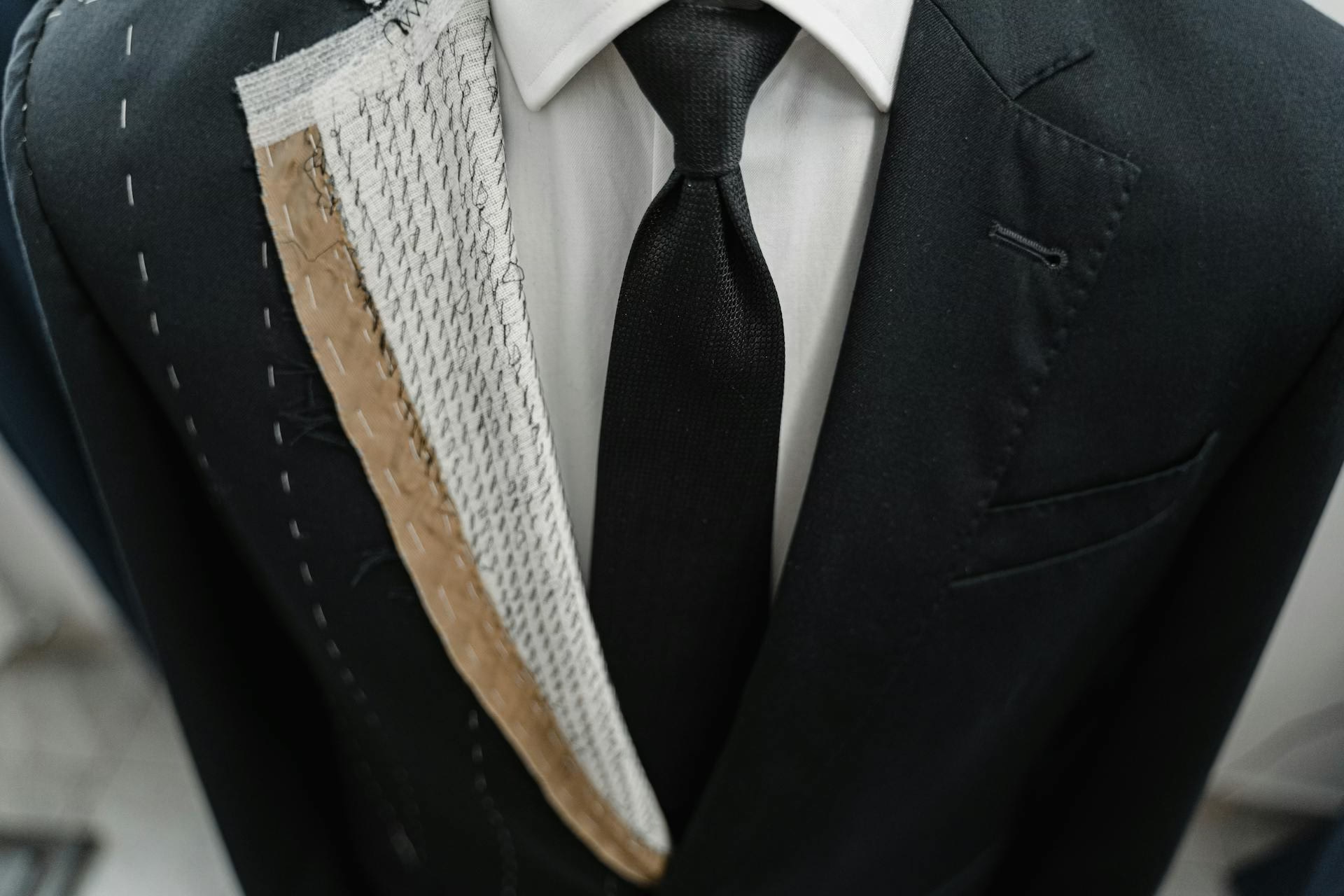
The shoulder seam on a suit jacket should sit at the edge of your shoulder, right where the bone ends and the shoulder starts to curve down into the arm. From there the sleeve should fall straight and smooth, with no dent below the seam, no pulling across the top, and no fabric hanging past your arm.
That one line does more work than any other part of a jacket. It sets the width of your frame, controls how the sleeve hangs, and decides whether the chest and back lie clean. It is also the hardest part of a jacket to change after it has been made, which is why it is the first thing a good tailor looks at and the clearest difference between off-the-rack and bespoke suits.
What Is the Shoulder Seam?
The shoulder seam is where the body of the jacket meets the sleeve at the top of your arm. On a jacket it usually runs around the sleeve head, the rounded top of the sleeve, where the sleeve is sewn into the armhole. On a dress shirt it is the line where the sleeve joins the shirt body.
Tailors also talk about the shoulder line. That is the line from the base of your collar out to the shoulder seam. It shows the slope and width of the jacket’s shoulder, and it should follow the shape of your own shoulder instead of sitting flat above it or sagging below it.
When a size chart lists shoulder width “seam to seam,” it means the distance across the back from one shoulder seam to the other. It is one of the most useful numbers to know, because it is the one measurement a tailor can’t easily change on a finished jacket. Our measuring guide walks through how it is taken.
Where Should the Shoulder Seam Fall?
On a well-fitted jacket the seam sits at, or just past, the outer edge of your shoulder bone. Gentleman’s Gazette describes it as “just slightly extended from the bone on your shoulder,” which matches what we look for in a fitting.
Here is what a correct shoulder looks like in the mirror:
- The seam sits at the natural edge of your shoulder, not up on top of it and not down on your arm
- The sleeve falls in a straight, clean line from the seam to your hand
- There is no dent or divot in the sleeve just below the shoulder pad
- There is no ridge of fabric across the top of the shoulder
- The collar stays against your shirt collar when you turn and move
- You can reach forward and lift your arms without the whole jacket riding up
A quick check at home: stand side-on to a wall and lean your shoulder into it. If the jacket’s shoulder touches the wall well before your own shoulder does, the jacket is too wide. If the seam is pulled up onto the top of your shoulder and the sleeve feels tight at the top of your arm, it is too narrow.
What About a Shirt Shoulder Seam?
The same rule applies to dress shirts, and it holds for men and women. The seam should sit at the edge of the shoulder. If it drops down onto the upper arm, the shirt is too big and you will see extra fabric bunching under a jacket. If it sits up toward the neck, the shirt will pull across the back when you reach forward. Casual and oversized shirts are often cut with a dropped shoulder on purpose, but a dress shirt worn under tailoring should not be. Our hand-crafted shirts are cut to your measured shoulder for exactly this reason.
Common Shoulder Fit Problems
Most people can tell when a jacket feels wrong without knowing why. The shoulder is often the reason. These are the signs we see most:
| What You See | What It Usually Means |
|---|---|
| Seam hangs past your shoulder onto your arm | The jacket is too wide in the shoulders |
| A dent in the sleeve just below the shoulder pad | The shoulder is too wide or the pad extends past your frame |
| Fabric pulls tight across the top of the sleeve | The shoulder or armhole is too narrow |
| Fabric collapses or folds near the collar | The jacket’s shoulder slope doesn’t match yours |
| Diagonal wrinkles from collar toward the armpit | Square or sloped shoulders cut for the opposite shape |
| The collar lifts away from your neck | The jacket’s balance doesn’t suit your posture |
| Tightness across the upper back when you reach | Too little room through the back and shoulders |
| One side sits lower than the other | A natural shoulder imbalance the jacket doesn’t account for |
If several of these sound familiar, our post on signs your suit doesn’t fit properly covers the rest of the jacket, and how to know if a suit fits well gives you a full head-to-toe check.
Why the Shoulder Is So Hard to Alter
A tailor can shorten sleeves, take in a waist, and hem trousers fairly easily. The shoulder is different. It is built from the shoulder pad, the canvas, the sleeve head and the armhole, and all of them connect to the chest, the back and the collar. Moving the seam means taking much of the top of the jacket apart and rebuilding it, and the result rarely looks as clean as the original.
That is why most tailors advise against it. Gentleman’s Gazette’s guide to suit alterations lists shoulder width as a change that is “not recommended.” When you buy off the rack, buy for the shoulders first and tailor everything else. We go into more detail in can off-the-rack suits be tailored?
Why Standard Sizes Miss the Shoulder
Ready-to-wear sizing is graded from the chest. It assumes that two people with the same chest measurement have the same shoulder width, slope and posture. They rarely do.
Two men who both wear a 40R can have completely different shoulders. One has square shoulders and the other has sloped ones. One stands upright and the other leans forward from years at a desk. One has a right shoulder slightly lower than the left, which is very common. Each of these changes how fabric falls from the collar to the arm, and a standard pattern can’t account for any of them.
Athletic builds feel this most. A broad back and developed shoulders usually mean sizing up the jacket to fit, then living with a loose waist and long sleeves. We wrote about that in custom suits for weight lifters.
Shoulder Slope and Posture
Slope is the angle your shoulder makes as it runs from your neck to your arm. Square shoulders run nearly flat. Sloped shoulders drop away more steeply. A jacket cut for square shoulders on a sloped frame leaves loose fabric folding near the collar. A jacket cut for sloped shoulders on a square frame pulls and wrinkles across the top.
Posture changes the balance of the whole jacket. If your shoulders roll forward, the back of a standard jacket rides up and the front swings open. In a bespoke fitting the tailor watches how you stand naturally and adjusts the pattern before the cloth is cut, so the jacket hangs evenly when you are relaxed, not only when you stand up straight for the mirror.
The Armhole Matters Too
The shoulder seam connects directly to the armhole, and the two work together. A higher, closer armhole lets you raise your arm without the whole jacket lifting with it, and it keeps the sleeve close to your body for a cleaner line. A low, loose armhole, common on off-the-rack jackets because it fits more bodies, looks roomy but moves worse. When the shoulder and armhole are cut for you, the jacket looks sharp standing still and stays put when you move.
Types of Jacket Shoulders
Once the seam is in the right place, the next choice is how the shoulder is built. This is a style decision as much as a fit one.
- Structured shoulder: a firmer pad and canvas give a clean, defined line. It suits business suits and anyone who wants a sharper frame.
- Natural or soft shoulder: little or no padding, so the jacket follows your own shoulder. It is relaxed and works well on sport coats and custom blazers.
- Roped shoulder: the sleeve head is raised slightly above the shoulder line, giving a small ridge at the seam. It reads as formal and is a classic choice for dinner jackets and wedding suits.
- Spalla camicia: Italian for “shirt shoulder.” The sleeve is set into the jacket the way it is on a shirt, often with a little gathering at the seam. Permanent Style has a clear explainer on what the term does and doesn’t mean.
The right shoulder depends on your build and where you will wear the jacket. A softer shoulder suits a business casual sport coat, while a wedding suit usually wants a little more structure so it holds its shape in photos. Our guide to blazer vs suit jacket fit explains how the shoulder changes between the two.
Why the Shoulder Matters for Wedding Suits
A wedding suit is photographed from every angle, for hours, while you stand, sit, hug people and dance. A shoulder that fits keeps the jacket looking sharp in posed portraits and in candid shots, and it keeps you comfortable all day. It is one of the first things we fit on custom wedding suits. If you are planning ahead, our groom’s wedding suit guide covers timing and fittings.
How Bespoke Gets the Shoulder Right
In a bespoke fitting the shoulder is measured, observed and then checked again in the cloth. We take your shoulder width, slope and posture, note any difference between your left and right sides, and build the pattern around them. At the fitting we check the seam position, the sleeve hang and how the jacket moves before anything is finished.
Getting it right doesn’t make the shoulder stand out. When it fits, nobody notices the shoulder at all. They just notice that the jacket looks right on you.
If your jackets always seem to miss at the shoulders, book a fitting at The Tailored Foundation or call us at (224) 628-2980.
See more from The Tailored Foundation on Google
Add us as a preferred source and our style guides and tailoring advice will show up more often in your Google results.